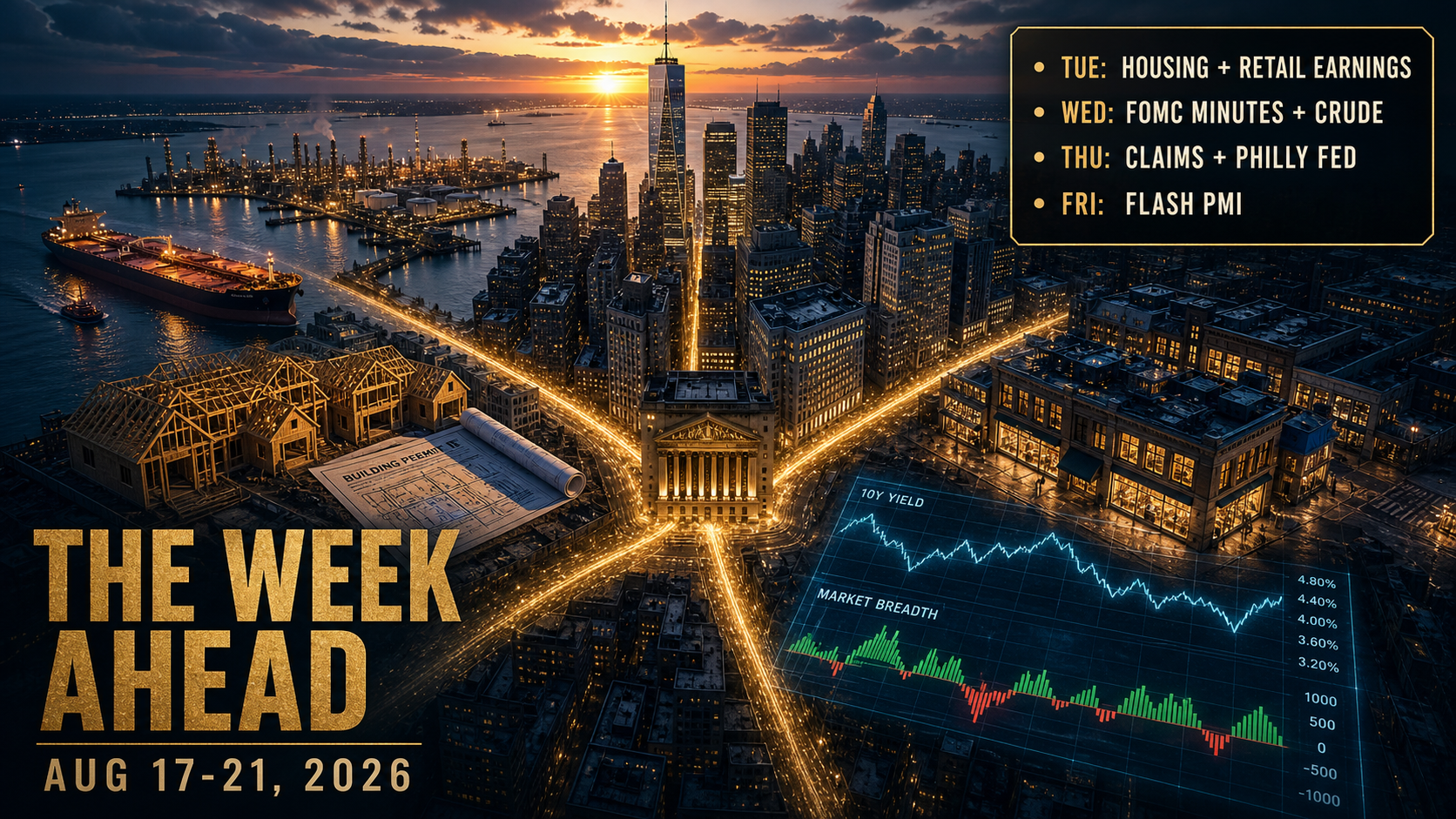
Bad News Stopped Paying. Now the Fed Has to Show Its Hand.
FOMC minutes, housing data, industrial production, jobless claims, and retail earnings test whether weaker growth still supports risk assets or finally becomes the risk.
August 17-21, 2026
Deck: FOMC minutes, housing data, industrial production, jobless claims, and retail earnings will test whether weaker growth still supports risk assets or finally becomes the risk.
The market spent Friday proving that an old reflex can become an expensive assumption.
July retail sales fell 0.6%, the weakest monthly result since May 2025. Nasdaq futures initially pushed through 30,250 as traders reached for the familiar bad-news-is-good-news playbook. Then the move failed. NQ reversed toward the 30,027 prior-day median, the S&P 500 slipped from Thursday's record, and the Nasdaq Composite finished lower.
That is the setup for this week. The question is no longer whether soft data can pull rate expectations lower. It is whether lower-rate hope can still outweigh the growth warning underneath the data.
Wednesday's FOMC minutes sit in the middle of that argument. They will not tell traders where price must go. They may reveal how difficult it will be for the market to keep treating every weak number as automatic fuel.
The Handoff From Last Week
The headline indexes hid a more useful story. For the week, the S&P 500 gained 0.4% and the Nasdaq Composite added just 0.1%, while the Russell 2000 rose 1.1% and the Dow lost 0.6%. Thursday produced a fresh S&P 500 record after wholesale inflation cooled, but Friday's retail-sales miss could not hold the initial growth-stock bid.
That leaves three tensions unresolved:
- Soft data is no longer a free pass. A weaker economy may lower yields, but it can also challenge earnings and expensive valuations.
- Breadth is trying to improve. Small caps outperformed last week, so RTY can help distinguish healthy rotation from simple Nasdaq fatigue.
- Energy is still an inflation input. Brent crude finished Friday at $88.52 as geopolitical supply uncertainty remained active. The Fed can discuss policy; it cannot vote oil lower.
This week is about which tension earns confirmation.
The Week's Decision Points
All times are Eastern.
| Day | Time | Confirmed event | What traders need to learn |
|---|---|---|---|
| Monday, Aug. 17 | 8:30 a.m. ET | Empire State Manufacturing Survey | Whether regional manufacturing confirms or contradicts the growth warning from retail sales |
| Tuesday, Aug. 18 | 8:30 a.m. ET | Import/export prices and housing starts/building permits | Whether imported inflation and residential activity reinforce the same macro story |
| Tuesday, Aug. 18 | 9:15 a.m. ET | Industrial production and capacity utilization | Whether the production side of the economy is holding up as consumer data softens |
| Tuesday, Aug. 18 | 10:00 a.m. ET | Pending home sales | A second housing read after the premarket construction data |
| Wednesday, Aug. 19 | 10:30 a.m. ET | EIA petroleum inventories | Whether crude's geopolitical premium receives confirmation from U.S. supply data |
| Wednesday, Aug. 19 | 2:00 p.m. ET | July 28-29 FOMC minutes | How broad the appetite for tighter policy was beyond the three formal dissenters |
| Thursday, Aug. 20 | 8:30 a.m. ET | Initial jobless claims and Philadelphia Fed Manufacturing Survey | Whether labor resilience and regional growth support or challenge Tuesday's signals |
| Friday, Aug. 21 | 9:45 a.m. ET | S&P Global Flash U.S. PMI | Whether August business activity confirms the week's official and regional growth signals |
Friday's flash PMI is the final confirmation test. It can show whether the week's housing, production, and regional-manufacturing signals are becoming a broader August trend. Thursday's close and Friday's response will reveal whether the market accepted the week's repricing or merely reacted to it.
Why These Fed Minutes Matter
The July FOMC decision was not a routine hold. The Committee kept the federal-funds target at 3.50%-3.75% by a 9-3 vote, while three members preferred a 25-basis-point increase. The statement described economic activity as solid and inflation as elevated, with energy-related supply shocks contributing to price pressure.
The minutes are backward-looking, especially after another jobs report and a full inflation-and-retail sequence. Their value is not a secret forecast for September. Their value is the reaction function.
Traders should look for three things:
- How many participants were open to a hike even if they did not dissent.
- What evidence the Committee needs before treating softer growth as disinflation rather than deterioration.
- How much weight policymakers place on energy-driven inflation versus weakening consumer demand.
The first headline after 2:00 p.m. is not the trade. Watch whether Treasury yields, NQ, the dollar, gold, and crude tell the same story after the initial algorithmic move.
Retail Earnings Put the Consumer Back on Trial
Home Depot reports Tuesday at 9:00 a.m. ET. Target reports Wednesday at 8:00 a.m. ET. Lowe's is scheduled for Wednesday at 9:00 a.m. ET. Together, they provide a practical read on discretionary demand, housing-linked spending, promotions, margins, and the consumer's willingness to absorb higher prices.
That makes Tuesday and Wednesday more than a macro calendar. Housing data will describe activity; Home Depot and Lowe's can describe the customer behind it. Target can show whether Friday's weak retail report was a broad warning or a noisy aggregate.
For index traders, guidance matters more than one quarter's earnings beat. A weak report with credible forward demand can trade differently from a backward-looking beat paired with margin pressure and cautious guidance.
Three Paths Through the Week
1. Soft growth earns a clean risk-on response
Housing and production cool without collapsing, claims remain controlled, yields move lower, and NQ holds gains instead of repeating Friday's failed breakout. RTY participation would strengthen the signal. This path is confirmed by acceptance, not by the first green candle after a release.
2. The market hears stagflation, not relief
Import prices or crude remain firm while activity data weakens, and the FOMC minutes reveal broader concern about inflation. Yields may refuse to provide a clean tailwind, NQ may underperform, and gold may strengthen without helping equities. That is a different regime from simple bad-news-is-good-news trading.
3. Rotation masks an index-level stall
Large-cap technology chops while RTY and selected consumer or industrial names carry the tape. This can keep ES stable without giving NQ a durable breakout. Do not mistake a flat headline index for a dead market; leadership and location determine the opportunity.
The PonoTrading Plan
Do not spend this week predicting the sentence buried in the Fed minutes. Prepare the locations where the market must prove that the sentence matters.
Start with the weekly dealing range, prior-day high and low, prior-day median, and the large round-number levels. Around each red-folder window, decide in advance whether you are trading a sweep, a rejection, or sustained acceptance. If price reaches your level without cross-asset confirmation, the absence of confirmation is information.
The trader who survives this week will not be the one with the loudest macro opinion. It will be the one who knows where the thesis is wrong, reduces size before the release, and refuses to marry the first move.
Want the complete map instead of another prediction? Join the PonoTrading Kahuna ecosystem for the Prep Room, analyst commentary, indicators, risk tools, and the structure to prepare, execute, and review each session with a plan.
Bottom Line
Last week ended with a warning: weak data can still move rates, but it no longer guarantees that growth stocks get paid.
This week, manufacturing, housing, production, claims, retail earnings, crude inventories, and the FOMC minutes all interrogate the same market reflex. Do not decide the answer before price responds. Let rates confirm equities, let breadth confirm the index move, and let acceptance confirm the headline.
Bad news stopped paying on Friday. This week reveals whether that was one failed trade or a change in the rules.
Market data and calendar details were verified Sunday, August 16, 2026. Scheduled events can change. Futures involve substantial risk. This material is educational and is not financial advice.
Sources
- Federal Reserve July 29, 2026 FOMC statement
- Federal Reserve August 2026 calendar
- Federal Reserve Bank of New York August 2026 economic calendar
- BLS August 2026 release schedule
- U.S. Census Bureau economic indicator calendar
- EIA Weekly Petroleum Status Report schedule
- Home Depot investor events
- Target investor events
- Lowe's investor events
- S&P Global PMI release calendar
- PonoTrading Market Pulse, August 14, 2026
- PonoTrading After the Close, August 14, 2026
- AP market close recap, August 14, 2026
Related Articles

Services Monday. Minutes Wednesday. CPI Still Ahead.
Soft bookend already printed. Path still 3.75–4.00%. This week is ISM Services Monday, trade Tuesday, FOMC minutes Wednesday — CPI is October 14, not this week. Miss = no chase.

PCE Wednesday. NFP Friday. Path Still Inherits.
Soft Claims stayed wire. Oil left the ladder Friday. Cash closed green. Path still 3.75–4.00%. This week bookends Wednesday Core PCE and Friday NFP — speakers are clocks, miss = no chase.

Path Inherited. Speakers First. Data Second.
First full cash week after the Sep 16 hike to 3.75%–4.00%. Board speakers Tue/Wed, flash PMIs Wednesday, claims and new-home sales Thursday, durable goods and final Michigan Friday. Digest the path — don’t invent a new thesis every print.