
The Most Expensive Bias Is the One That Just Paid You
NQ swept the prior-day high, reached PDM liquidity, and reversed. See how the PonoTrading analyst shorted the objective, flipped bullish, and managed the rebound.
Friday, August 14, 2026
The market paid his short. Then it dared him to stay bearish.
Most traders spend the afternoon defending the bias that paid them in the morning. PonoTrading's analyst did the opposite. He mapped the prior-day high sweep, traded the rotation toward the prior-day median, took profits, and then did the harder thing: recognized that the first idea had completed and flipped bullish near the New York session floor.
That decision turned a good read into a complete session.
NQ futures reached approximately 30,280.50, failed just below the morning Market Pulse trigger at 30,283, and broke both 30,247 and 30,188 on the way to roughly 30,028.50. The move delivered the consumer-warning path described before the open. But the market did not become a one-way liquidation. The Russell 2000 recovered, volatility eased, and NQ reached the 30,027 prior-day median (PDM) that had been treated as liquidity throughout the session.
That was the location where the map changed.
The analyst's timestamped Discord commentary documented the shift from a market-maker sell model into a buy model, the bullish entry structure near the low, staged exits, and a later pullback re-entry. Across those separate decisions, he captured more than 200 cumulative NQ points of directional movement while the underlying rebound from the New York low to the final 30,125 big-level target covered less than 100 points.
That is not a claim of one 200-point hold or 200 points of net account profit. It is the result of taking profit at key locations, re-entering when structure offered defined risk, and refusing to confuse a completed thesis with a permanent bias.
The Closing Scorecard
| Market | Closing / late-session reference | Session read |
|---|---|---|
| S&P 500 | 7,785.76 | -0.17%; lost the morning pivot, then stabilized above the low |
| Nasdaq Composite | 26,729.16 | -0.28%; growth lagged after the early NQ rejection |
| Dow | 53,732.41 | -0.20%; failed to provide upside confirmation |
| Russell 2000 | about 3,067.97 | +0.50%; recovered from an early break and became the positive breadth exception |
| NQ futures | about 30,147.50 | rejected 30,280.50, reached 30,028.50, then rebounded through 30,125 |
| ES futures | about 7,803.75 | broke 7,822.50 and reached roughly 7,796.50 |
| VIX / VXN | about 14.28 / 20.77 | both eased, arguing against a broad fear event |
| WTI crude | about 82.29 | recovered from 80.76 and finished firm |
| Gold | about 4,429.30 | expanded early before fading from the high |
| Dollar index | about 99.64 | remained below 100 |
Cash-index values are 4:00 p.m. ET closing prints. Futures, volatility, dollar, crude, and gold are delayed late-session references and may differ from official settlements.
What the Morning Market Pulse Got Right
The morning plan did not predict a single line from open to close. It defined proof.
The bullish relief scenario required NQ to hold above 30,250 and clear 30,283, with ES above 7,831.75 and confirmation from the other indexes. NQ traded to approximately 30,280.50 but never cleared the trigger. ES did not hold its requirement, and YM lagged.
The consumer-warning scenario required NQ to fail below 30,247 and lose 30,188, while ES lost 7,822.50. Every one of those large-cap conditions activated. Gold expanded during the early defensive response, adding cross-asset confirmation.
What did not arrive was a full market-wide risk event. RTY briefly lost its warning level near 3,053.50, reversed, and finished positive. VIX and VXN declined. Crude recovered. The warning path worked in NQ and ES, but the close showed rotation rather than panic.
That distinction is why a static bearish bias became dangerous near PDM.
PDH Was the Sweep. PDM Was the Liquidity.
PonoTrading treats the prior-day high, prior-day low, and prior-day median as parts of one liquidity map, not as isolated support and resistance lines.
Thursday's NQ prior-day high sat near 30,273.25. Friday's push to approximately 30,280.50 swept it. Once price failed to establish acceptance above the morning 30,283 trigger, the unfinished prior-day median near 30,027 became a logical downside objective.
At 11:27 a.m. ET, the analyst told the Discord trader chat that he was short from PDH toward 30,033 and was aiming for PDM. Minutes later, he documented the rejection structure and the continued pull toward that target. The trade was not based on guessing that price was "too high." It combined location, time, structure, and the liquidity objective.
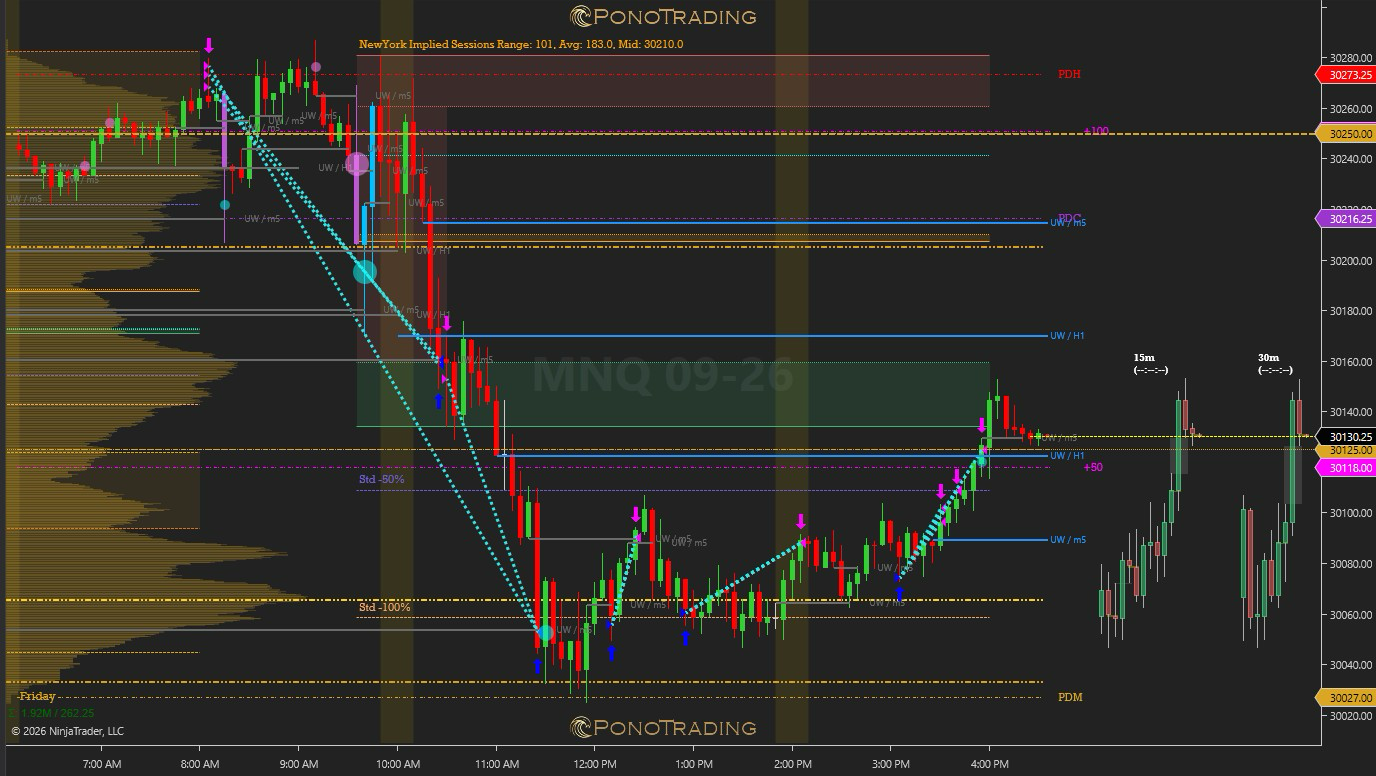
By lunch, the market had reached the objective within ticks. That matters because the logic that justified the short no longer justified holding it.
When the liquidity you were trading toward has been taken, the burden of proof changes.
The Flip Was the Trade
At 12:19 p.m. ET, the analyst described the transition from a market-maker sell model into a market-maker buy model. He repeatedly emphasized risk management and explained why the next opportunity was not an emotional attempt to catch the absolute low.
The setup used a 30-minute "stamp" reversal, lower-timeframe confirmation, and the untested wick structure above the low. The initial long was managed into nearby upper-wick and hourly references rather than held on hope. Before the next pullback arrived, the analyst said he expected it near the new 30-minute candle and would consider a re-entry only if the higher-timeframe support zone held.
At 12:40 p.m. ET, that pullback arrived. The follow-up entry used the five-minute stamp inside the higher-timeframe structure. The sequence was shared as it developed, not reconstructed after the close.
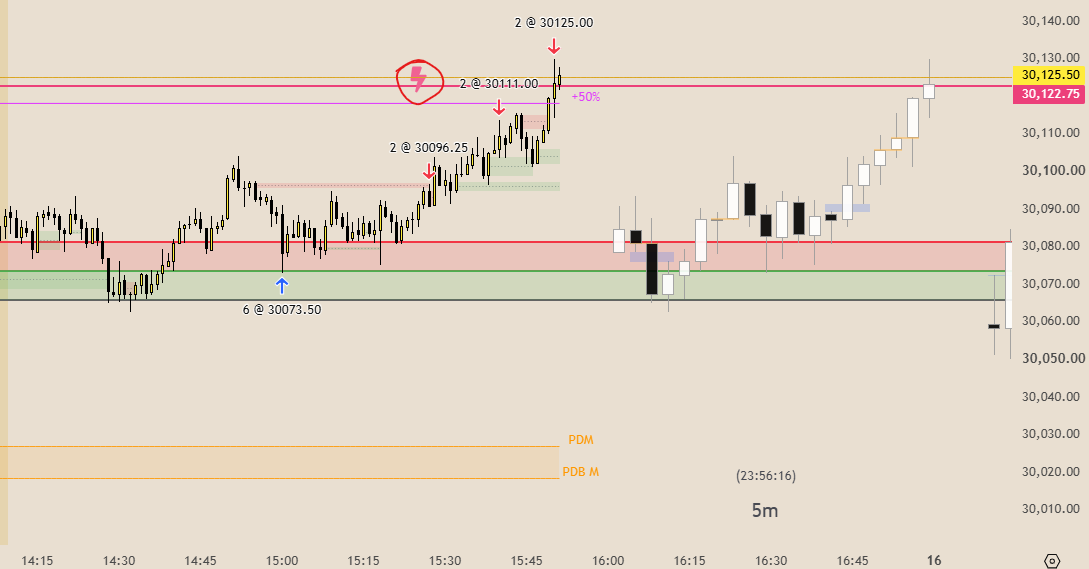
The final documented objective was the confluence near 30,125: a PonoTrading big level, an hourly reference, and the upper-wick target discussed in the room. The execution broke the rebound into multiple decisions:
- Enter where the structure defined invalidation.
- Take profit at nearby liquidity and reference levels.
- Allow the pullback instead of chasing the next candle.
- Re-enter only when timing and structure rebuilt the edge.
- Exit into the 30,125 confluence rather than demanding the closing high.
That is how cumulative directional capture can exceed the distance between the low and the final target. The edge comes from repeated, risk-defined participation in the movement, not imaginary precision at both endpoints.
Products Do Not Replace Judgment. They Organize It.
The session also showed how PonoTrading's products and risk logic fit together.
The PDH-PDM framework identified where liquidity was likely to pull price. Big Levels highlighted the 30,125 objective. Multi-timeframe stamp logic helped time the bullish reversal and pullback entry. The risk-management tools translated a predefined dollar-risk budget and invalidation distance into position size, allowing entries to be staged across a zone instead of improvised under pressure.
None of those tools guarantees a winner. Their purpose is more useful: force the trader to answer four questions before emotion does.
- Where is price likely seeking liquidity?
- What proves the current thesis complete or wrong?
- Where can risk be defined before entry?
- Where should profit be taken if the map works?
The analyst's strongest decision was not the short from PDH or the long from the floor. It was accepting that both could be correct at different locations on the same day.
The Lesson Traders Usually Learn Too Late
If your strategy cannot tell you when to stop being right, it is not a strategy. It is an attachment.
The morning short thesis worked. PDM was the target. Once the market reached that liquidity and printed reversal structure, staying bearish would have meant defending yesterday's edge against today's evidence.
Professionals do not get paid for loyalty to a direction. They get paid for reading location, defining risk, taking profits, and changing their mind when the auction changes.
That is the difference between predicting a move and capitalizing on how price actually moves.
Stop Trading the Bias. Start Trading the Map.
Before your next session, write down the prior-day high, low, and median; the nearest PonoTrading big levels; the liquidity objective; and the exact condition that would force you to flip your bias. Then size the trade from the invalidation, not from the profit fantasy.
Get the Free PonoTrading Risk Management Checklist
Want the live maps, trader commentary, and PonoTrading tools used to organize sessions like this one? Join Kahuna.
Bottom Line
Friday's large-cap warning path activated almost exactly as mapped. NQ failed below 30,283, lost 30,247 and 30,188, and reached approximately 30,028.50. ES lost 7,822.50. But Russell strength and falling volatility kept the move from becoming a broad liquidation.
The PonoTrading analyst traded the PDH sweep toward the PDM liquidity objective, took profits, flipped bullish near the floor, and used staged exits plus a structured pullback re-entry to capture more than 200 cumulative points of directional movement across separate trades. The final rebound objective at 30,125 was less than 100 points above the New York low.
The hook is not that someone called a bottom.
The lesson is that he stopped defending the trade that had already paid him.
Market observations were captured through the 4:00 p.m. ET cash close on Friday, August 14, 2026. Futures and cross-asset values are delayed references and may differ from official settlements. Trade commentary is based on timestamped PonoTrading Discord posts and chart captures. "More than 200 points" describes cumulative directional capture across multiple entries and exits, not one continuous position, a verified net-P&L figure, or a promise of results. Any fixed-dollar risk example is illustrative, not a recommendation. Educational content only; futures involve substantial risk and this is not financial advice.
Sources
- U.S. Census Bureau: Advance Monthly Sales for Retail and Food Services, July 2026
- U.S. Census Bureau: Manufacturing and Trade Inventories and Sales, June 2026
- Associated Press: U.S. stocks edge lower as oil rises and retail sales weaken
- Yahoo Finance delayed market data
- PonoTrading August 14 Market Pulse, expected-move framework, Big Levels, and timestamped Discord trader-chat record
Related Articles
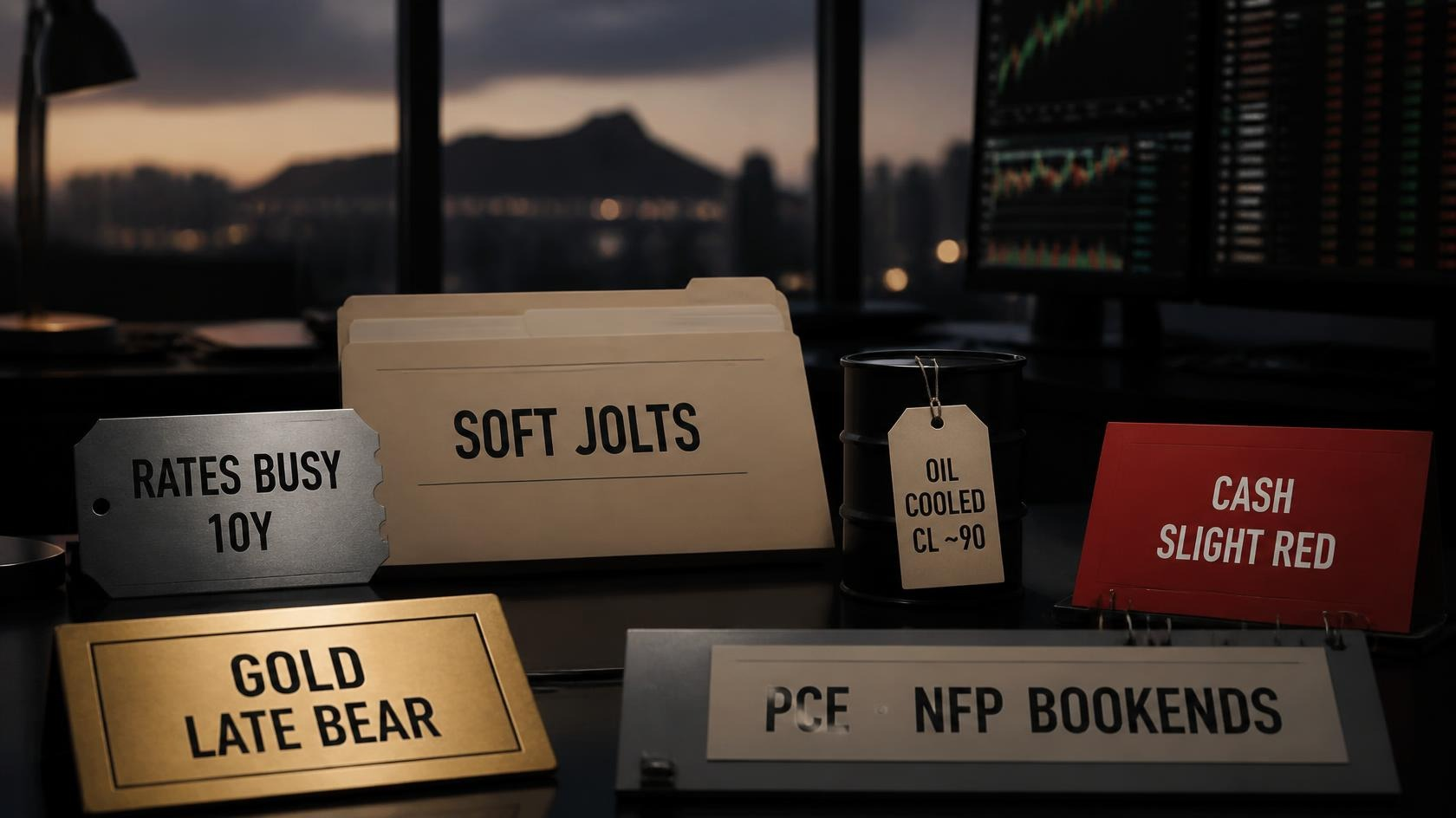
Rates Busy. Soft JOLTS. Oil Cooled. Gold Late Bear.
Prep framed Mon red cash, gold soft, and Tuesday JOLTS into PCE/NFP bookends. Soft JOLTS printed 7.079M. Cash slight red. Rates busy — AP 10Y 5.25%. Oil cooled — Brent $96.16; Spotter CL 90.07. Gold late bear 4194.5. Separate the clocks.
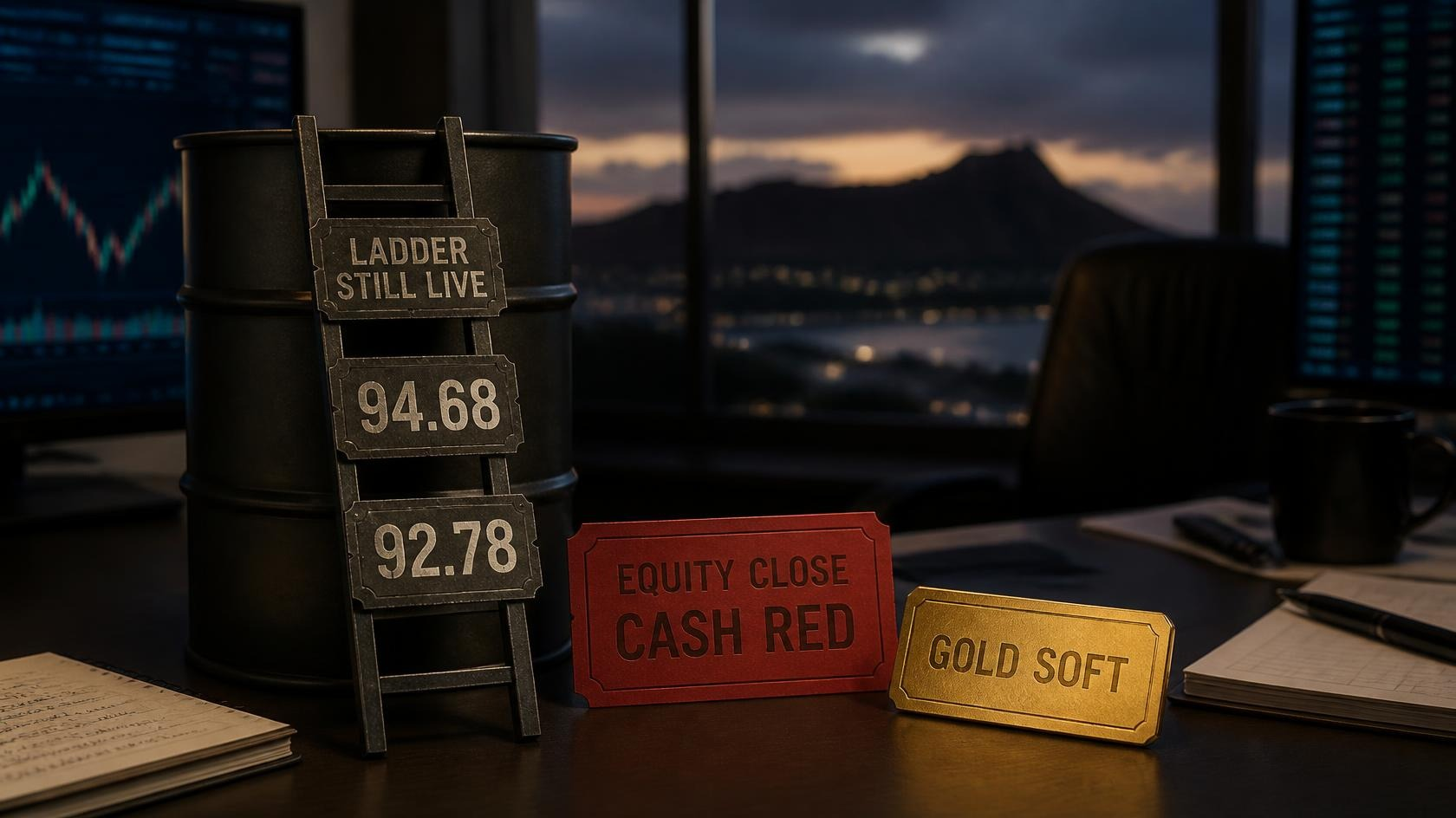
Ladder Still Working. Cash Went Red. Gold Soft.
Prep framed overnight oil spike, gold soft under expected-move lows, equities inside the daily expected move into a light Monday. Cash closed red. Spotter oil still working 94.68/92.78 — separate oil from red cash from soft gold.

Ladder Left Behind. Cash Went Green. Michigan Soft.
Prep asked oil continuation only at the overnight ladder. Cash printed lower on the CL tickets while equities closed green into the weekend. Final Michigan soft at 48.1 — separate the oil miss from the green cash.