Every Index Cleared +2SD as SpaceX Still Had to Prove the Spending
ES, NQ, YM and RTY closed beyond +2SD before SpaceX and AMD sold off after strong growth, exposing the market's demand for returns on AI and space capex.
Tuesday, August 4, 2026
The S&P 500, Dow, and Nasdaq closed at records, all four major U.S. index futures finished beyond the morning map's +2SD lines, and crude fell through its weekly lower band. Then SpaceX and AMD reminded traders that a strong tape does not lower the market's standard for expensive growth.
Tuesday was not merely a green session. It was broad statistical expansion.
Our morning Market Pulse identified daily +1SD at 7,691.72 on ES, 29,264.24 on NQ, 53,831 on YM, and 3,015.59 on RTY. By the 4:00 p.m. ET delayed futures observation, every contract had cleared not only +1SD, but its calculated +2SD boundary.
That is acceptance.
It is also where discipline gets harder. Once price has already traveled two standard deviations, the question changes from "can this break out?" to "what new information can keep buyers paying above the field?"
SpaceX and AMD supplied the first answer after the bell: headline growth was not enough to prevent profit-taking when capital intensity, expectations, and forward visibility remained the real valuation tests.
The Close: Broad Expansion, Not a One-Index Squeeze
The official cash indexes finished decisively higher:
- S&P 500: 7,736.52, up 1.8%
- Dow Jones Industrial Average: 54,085.88, up 1.7%
- Nasdaq Composite: 26,584.99, up 2.6%
- Russell 2000: 3,036.98, up 1.8%
The futures tape confirmed the breadth.
| Market | Morning +1SD | Morning +2SD | 4:00 p.m. ET observation | What price proved |
|---|---|---|---|---|
| ES | 7,691.72 | 7,754.69 | 7,774.25 | Accepted above +2SD into the close |
| NQ | 29,264.24 | 29,643.73 | 29,877.50 | Expanded more than 600 points above +1SD |
| YM | 53,831 | 54,272 | 54,324 | Preserved broad blue-chip confirmation |
| RTY | 3,015.59 | 3,040.28 | 3,048.20 | Small caps confirmed rather than diverged |
| CL | 77.77 daily -1SD | 75.37 weekly -1SD | $75.65 | Closed near the weekly lower boundary after trading below it |
Futures values are delayed five-minute observations near 4:00 p.m. ET, not official settlements or executable quotes.
This is the breadth traders wanted to see. NQ led, but YM and RTY did not get left behind. The 10-year Treasury yield eased to approximately 4.63%, while Brent crude fell 5.4% to $79.25. JOLTS showed nearly 7.4 million openings at the end of June, close enough to expectations to avoid disrupting the growth-and-rates balance.
The important wrinkle was volatility. VIX finished near 16.34, above Monday's close, and VXN ended near 25.32, also higher despite the index rally. That does not invalidate the breakout. It does tell us protection demand did not disappear while price extended.
The Morning Plan Versus the Outcome
The bullish path required NQ to accept above the overnight high near 29,245.75 and daily +1SD at 29,264.24, ES to hold above Monday's 7,628.75 close, RTY to maintain participation, and crude to stay contained.
All four conditions held.
NQ's cash-session low was approximately 29,208.25, then buyers drove it to a high near 29,956.50. ES advanced from roughly 7,656 to 7,786. RTY closed near its session high. Crude did more than remain contained: it fell to approximately $75.16, briefly trading below the weekly -1SD level at $75.37.
This is exactly why the map uses conditions instead of predictions. The opening print was constructive. The hold above the decision zone and the expansion across all four indexes made it tradeable structure.
SpaceX Earnings: The Revenue Beat Was Real
SpaceX's first report as a public company delivered far more operating progress than the after-hours stock reaction suggests at first glance.
For the quarter ended June 30, the company reported:
- Revenue: $7.814 billion, up 92% year over year
- Net loss: $541 million, improved from a $1.008 billion loss
- Loss from operations: $143 million, improved from $970 million
- Adjusted EBITDA: $3.538 billion, up 191%
- Cash and marketable securities: approximately $100.0 billion
- Backlog: $47.5 billion
Revenue exceeded the roughly $6.9 billion consensus cited by S&P Visible Alpha. The net loss was also substantially smaller than the $1.9 billion loss analysts surveyed by FactSet had expected before the release.
Those are strong headline results. The segment detail explains both the strength and the market's hesitation.
Starlink Is the Operating Engine
The Connectivity segment, which includes Starlink, produced the cleanest earnings quality in the report.
- Revenue rose 66% to $4.291 billion.
- Operating income increased 79% to $1.656 billion.
- Adjusted EBITDA reached $2.597 billion.
- Subscribers doubled year over year to 12.0 million.
- Enterprise and government revenue rose 108% to $1.806 billion.
Starlink average revenue per user held at $66 per month sequentially but remained below the prior-year $85. That tradeoff matters: subscriber scale is accelerating faster than monetization per user. The network is producing real operating income, but future margin quality depends on capacity, hardware economics, service mix, and continued growth in higher-value enterprise and government contracts.
SpaceX also disclosed more than $6 billion of multi-year U.S. government awards for Starshield. That backlog improves visibility, but it does not remove execution risk.
Launch Performance Improved While Starship Spending Stayed Heavy
SpaceX's launch operation produced $962 million of revenue, up 29% year over year and 55% sequentially. The segment completed 38 launches during the quarter and carried approximately 485 metric tons to orbit.
The company still recorded a $542 million operating loss in Space as research and development spending accelerated to $1.076 billion.
Operationally, management reported meaningful Starship progress:
- Flight 12 in May achieved liftoff from the new Starbase pad, a precision upper-stage landing, and deployment of modified V2 Starlink satellites.
- Flight 13 in July achieved all stated flight objectives, including deployment of 20 production V3 satellites, an in-space Raptor relight, and an intact heatshield through the softest Starship splashdown to date.
That is performance progress, not commercialization proof. The next valuation step requires reusability, cadence, and cost reduction to become repeatable economics. Management says Starship can reduce cost to orbit by 99% or more relative to historical averages. Investors still have to decide how much of that future belongs in today's price.
AI Produced Growth, EBITDA, and the Largest Question
The AI segment generated $2.561 billion of revenue, up 247% year over year. Adjusted EBITDA improved to $1.146 billion, and management disclosed $14.1 billion of contracted cloud-services sales.
But GAAP operating loss remained $1.257 billion, and quarterly AI capital expenditure reached $15.828 billion, up from $749 million a year earlier. Total company capex was $18.369 billion for the quarter.
That is the fulcrum of the report.
SpaceX has a profitable connectivity engine, improving launch performance, roughly $100 billion of liquidity after its IPO and bond issuance, and fast-growing AI revenue. It is also spending at a rate that requires unusually strong utilization and pricing to produce durable returns.
On the call, Elon Musk said SpaceX plans to build its data centers exclusively around Nvidia's Vera Rubin architecture. Nvidia shares strengthened after hours while SpaceX shares fell roughly 6%-8% from their reported $125.33 regular-session close in the early post-market window.
The market's first read was not that the quarter was weak. It was that the burden of proof still sits with future returns on capital.
The Lockup Matters as Much as the Quarter
SpaceX rallied 9.4% during the regular session ahead of earnings but remained below its $135 IPO price and far below its June peak above $225. More than 900 million insider shares are scheduled to become eligible for sale beginning Thursday, according to Associated Press reporting.
That potential supply can overpower otherwise favorable fundamentals in the short run. A revenue beat does not control the float.
For traders, the key SpaceX levels are therefore structural rather than emotional:
- Holding the post-earnings low near $114 would show buyers are defending the pre-report base.
- Reclaiming the $123-$125 closing area would begin to reject the initial selloff.
- Acceptance below $114 as the lockup expires would keep supply and capital-spending concerns in control.
- The $135 IPO price remains the larger repair threshold.
AMD: A Beat That Still Failed the Expectations Test
AMD also demonstrated the difference between business growth and price acceptance. The company reported approximately $11.5 billion of revenue, up 50% year over year, with Data Center revenue near $6.7 billion, more than double the prior-year period. Third-quarter revenue guidance centered near $13.0 billion.
AMD nevertheless traded roughly 9% lower in the early after-hours window after closing at $520.61. The market had already paid for a high bar, and investors wanted a faster AI acceleration path.
That reaction matters for Wednesday's NQ handoff. During the cash session, semiconductors confirmed the rally. After the bell, AMD weakened SMH while Nvidia gained on SpaceX's exclusive-compute comments. The sector is no longer one trade; it is discriminating between current spending beneficiaries and companies still proving the timing of their AI revenue ramps.
Asia and London Decision Map
Tuesday's +2SD close changes the overnight playbook. The market is extended, but extension alone is not a short signal.
Continuation with acceptance
- ES holds above 7,754.69, Tuesday's +2SD line.
- NQ holds above 29,643.73 despite AMD weakness.
- RTY stays above 3,040.28, preserving breadth.
- The 10-year yield remains near or below the mid-4.60% area.
- Crude remains below $77.77 without a violent reclaim.
That combination would show the index breakout can absorb company-specific earnings disappointments.
Constructive digestion
- ES and NQ rotate back inside +2SD but hold their +1SD levels at 7,691.72 and 29,264.24.
- YM and RTY retain most of Tuesday's advance.
- VIX and VXN stop rising.
After a two-standard-deviation expansion, consolidation would be normal. The trade becomes location and patience, not chasing or automatically fading.
Failed acceptance
- NQ loses 29,264.24 and cannot reclaim it.
- ES loses 7,691.72 while RTY falls back below 3,015.59.
- AMD weakness broadens through semiconductors, VXN rises, or crude reverses above Monday's $80.17 anchor.
That would tell us Tuesday's record close was an exhaustion event rather than the start of a new accepted range.
Bottom Line
Tuesday proved broad equity acceptance. All four index futures finished beyond +2SD, yields eased, crude broke lower, and small caps confirmed the move.
SpaceX proved something different. Revenue growth, Starlink profit, launch progress, and AI contracts were all real. So were the $18.4 billion of quarterly capex, the remaining GAAP losses, and the incoming insider supply. The after-hours decline was the market asking for returns on that spending, not denying the operating progress.
The professional move tonight is to respect both facts. Do not short a +2SD index close merely because it is extended. Do not buy an earnings beat merely because the headline is impressive. Let price show whether Tuesday's accepted levels survive the overnight handoff and whether SpaceX can defend the base beneath its report.
Use the free Survive First risk-plan builder to define tomorrow's invalidation and maximum loss before Asia builds the next range.
Market-data note: Official cash-index closes are from Associated Press. Futures, volatility, yields, and after-hours prices are delayed observations captured between 4:00 and approximately 5:35 p.m. ET on August 4, 2026; they are not official settlements or executable quotes. SpaceX financial and operating figures are from its August 4 SEC-filed earnings release. Educational content only. Futures and equities involve substantial risk. This is not financial advice.
Sources
Related Articles
Rates Busy. Soft JOLTS. Oil Cooled. Gold Late Bear.
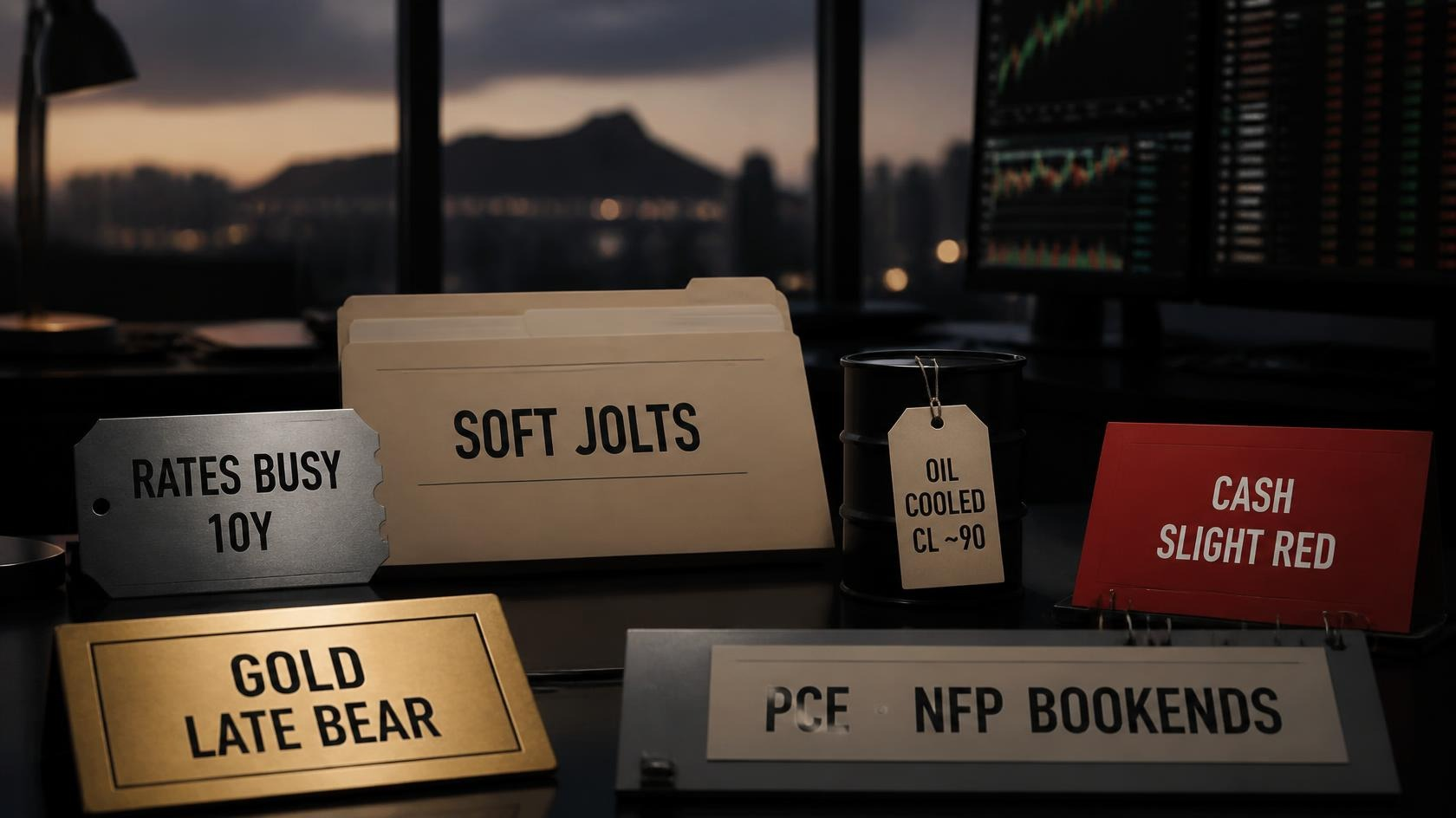
Prep framed Mon red cash, gold soft, and Tuesday JOLTS into PCE/NFP bookends. Soft JOLTS printed 7.079M. Cash slight red. Rates busy — AP 10Y 5.25%. Oil cooled — Brent $96.16; Spotter CL 90.07. Gold late bear 4194.5. Separate the clocks.
Ladder Still Working. Cash Went Red. Gold Soft.
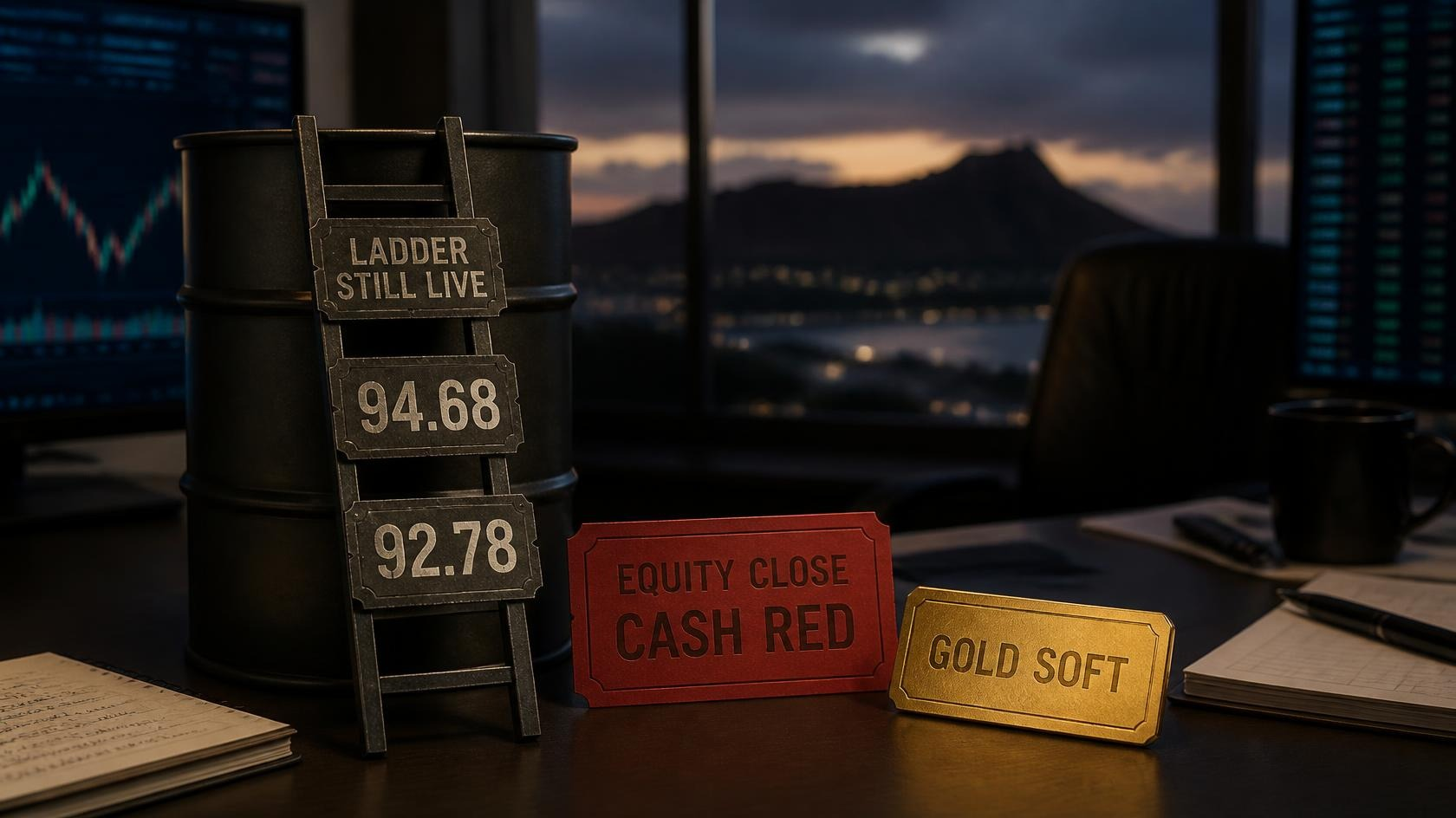
Prep framed overnight oil spike, gold soft under expected-move lows, equities inside the daily expected move into a light Monday. Cash closed red. Spotter oil still working 94.68/92.78 — separate oil from red cash from soft gold.

Ladder Left Behind. Cash Went Green. Michigan Soft.
Prep asked oil continuation only at the overnight ladder. Cash printed lower on the CL tickets while equities closed green into the weekend. Final Michigan soft at 48.1 — separate the oil miss from the green cash.