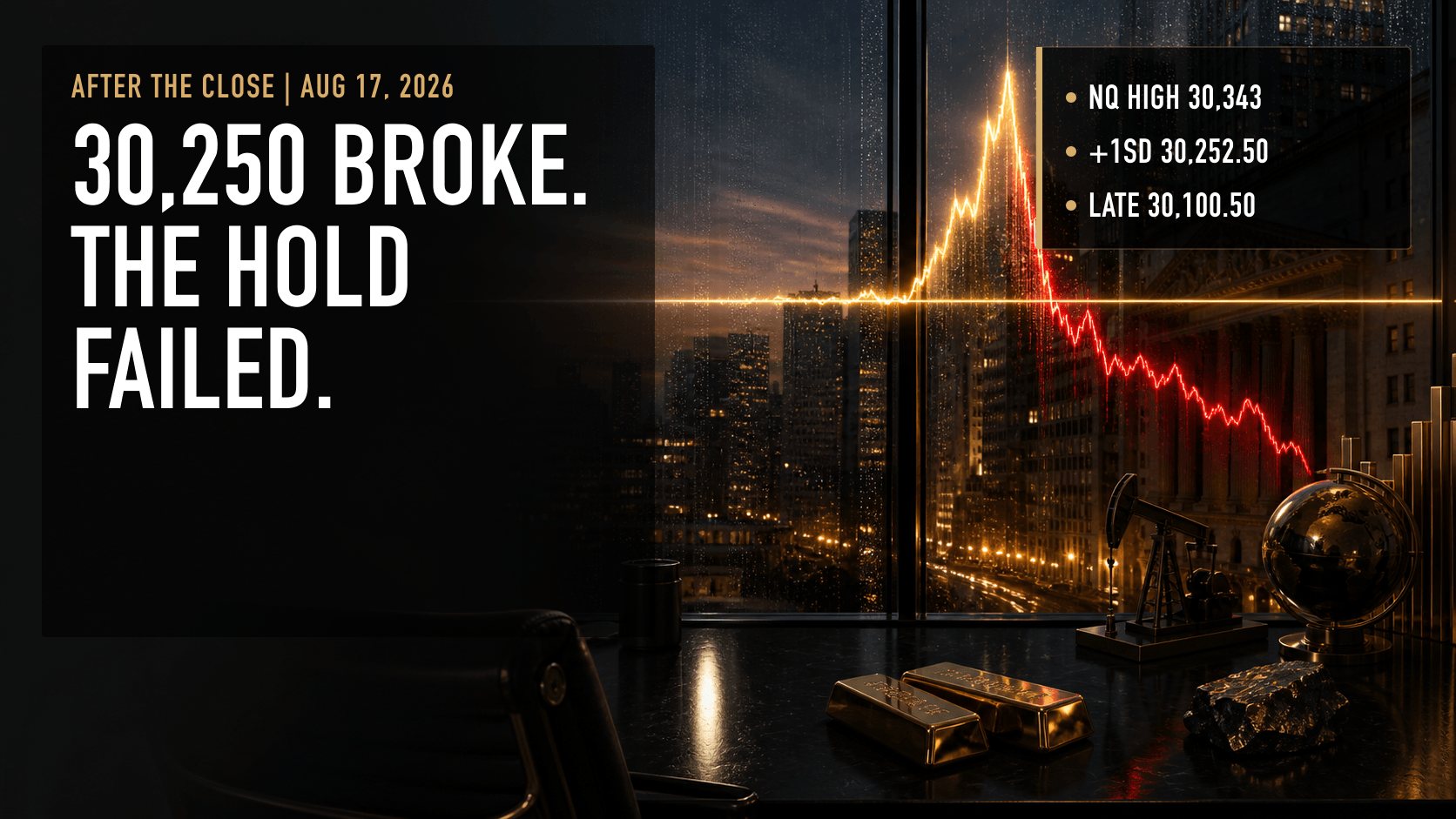
The Breakout Happened. The Acceptance Never Did.
NQ traded above 30,250 and daily +1SD, reached 30,343, then failed acceptance, lost 30,180, and finished the late session near 30,100. The breakout printed; the hold never did.
After the Close | August 17, 2026
Nasdaq broke the level. Then it failed the only test that mattered: holding it.
NQ futures pushed through the Pono Big Level at 30,250 and the daily +1 standard-deviation level at 30,252.50, reaching 30,343. That looked like a breakout on the screen. It never became acceptance.
Once buyers failed to build value above the confluence, NQ slipped back through the level, lost the morning 30,180 trigger, traded down to 30,066.50, and was near 30,100.50 in the late session. The excursion above +1SD was real. So was the rejection.
That distinction was the session.
Closing Scorecard
| Market | Session read | What mattered |
|---|---|---|
| NQ futures | High 30,343; low 30,066.50; late session near 30,100.50 | Traded above 30,250/+1SD, then failed acceptance and lost 30,180 |
| ES futures | High 7,824.50; low 7,766.25; late session near 7,770.75 | Broad risk appetite weakened into the close |
| QQQ | About -0.15% | Nasdaq cash proxy finished red despite the intraday extension |
| SPY | About -0.47% | Broader market weakness confirmed the fade was not isolated |
| DIA | About -0.48% | Industrials also closed lower |
| IWM | About -0.34% | Small caps did not provide a breadth rescue |
| TLT | About -0.80% | Treasury weakness kept rates pressure in the conversation |
| Crude oil futures | About +2.67% | Oil strength added another inflation-sensitive cross-current |
| Gold futures | About +0.87% | Gold remained firm while equities softened |
Futures figures are delayed late-session daily bars and are not official settlement values. ETF figures are closing IEX bars.
What This Morning's Market Pulse Got Right
The morning report warned traders not to confuse a strong factory headline with automatic bullish acceptance.
The August Empire State Manufacturing Survey strengthened to 20.6, with new orders, shipments, unfilled orders, delivery times, and pricing pressure all showing activity beneath the headline. That data helped keep yields firm, but it did not produce broad, durable equity participation.
More importantly, the report defined the actual decision zone before the move happened:
- Bullish continuation required a reclaim and hold of 30,250-30,253 with broader participation.
- The rejection scenario required failure at that zone, a loss of 30,180, and no immediate reclaim.
Price tested both ideas. Only one survived the close.
A Breakout Is Not Acceptance
Trading above a level proves that price can reach it. Acceptance requires more.
Traders need to see price hold above the level, survive a retest, and attract enough participation to build value there. NQ did the first part and failed the rest. The market printed more than 90 points above daily +1SD, but the late-session indication sat roughly 150 points back below it.
That is why PonoTrading treats major levels as decisions, not decorations. The level does not tell you to buy or sell. The response tells you whether the auction found agreement or rejection.
The Cross-Asset Message
The fade was not happening in a vacuum.
Treasuries weakened, oil rallied sharply, gold stayed firm, and the major equity ETFs closed lower. That combination left traders balancing resilient economic activity against persistent rate and inflation pressure. Nasdaq briefly stretched beyond its expected range, but the broader tape never delivered the confirmation needed to sustain the extension.
The market did not punish traders for knowing the level. It punished anyone who treated the first print above it as proof.
The Process Lesson
Do not trade the breakout you want. Trade the acceptance the market proves.
A disciplined plan for this setup was straightforward:
- Mark the 30,250/+1SD confluence before price arrives.
- Require acceptance above the zone before treating it as support.
- If price rejects and loses 30,180, stop arguing with the failed breakout.
- Reduce risk when breadth and cross-asset behavior do not confirm the move.
- Take profits at key locations instead of demanding that every excursion become a trend day.
The goal is not to predict every turn. It is to know exactly what evidence changes the trade.
Asia and London Handoff
Asia inherits a failed NQ breakout, not a confirmed trend reversal. The immediate decision range is 30,066.50 to 30,180. Holding below 30,180 keeps the rejection active; acceptance below 30,066.50 opens the door to a fresh test of 30,000. A reclaim of 30,180 would repair the first layer of damage, but it would not restore the breakout by itself.
London's job is to determine whether Asia built value below the failed trigger or repaired the auction. Bullish continuation requires NQ to reclaim 30,250-30,253, hold the zone on a retest, and show broader participation. Bearish continuation requires another rejection below 30,180 followed by acceptance under 30,066.50. Rotation between those references is balance, not proof, and is the easiest place to overtrade.
Carry one question into both sessions: did price merely revisit the level, or did the market prove it can live there?
Turn Levels Into a Repeatable Workflow
If your trading still changes every time a candle moves, the problem is not another indicator. It is the lack of a repeatable preparation, execution, and review process.
Explore the PonoTrading Expected Move tools to frame statistically important range boundaries before the session. Then join Kahuna for the complete PonoTrading ecosystem: Mission Control, advanced tools, premium community access, risk workflows, FundedFlow review, and the structure to act on the plan without chasing price.
The level gets your attention. The response earns your risk.
Educational content only. Futures and leveraged products involve substantial risk and are not suitable for every trader. Nothing here is financial advice or a promise of performance.
Source Notes
- PonoTrading Market Pulse, August 17, 2026
- Federal Reserve Bank of New York, August 2026 Empire State Manufacturing Survey
- National Association of Home Builders, HMI release calendar
- Associated Press market coverage, August 17, 2026
- Delayed futures market data and IEX closing ETF bars
Related Articles
Soft NFP. Soft Wage. Bookend Soft. Yields Bounced.
Soft NFP +29k / soft wage (wire only). Soft Claims 197k already on board. Cash green — S&P 7,722.72 (+0.7%), Dow 51,176.96 (+0.5%), Nasdaq 27,190.86 (+1.2%), Russell 2,832.90 (+0.9%). AP 10Y below 5.17% → 5.28%. Spotter GC 4184.2 / SI 60.95 / 10Y 5.243 / 6E 1.13; late HG 6.5775. Soft bookend closed.
Soft Claims. Yields Flipped. Modest Green. NFP Ahead.
Soft Claims printed 197k (wire only). Cash modest green — S&P 7,666.45 (+0.2%), Dow 50,926.56 (<0.1%), Nasdaq 26,871.60 (<0.1%), Russell 2,806.63 (+0.3%). AP 10Y near 5.34% → 5.24%. Spotter NQ h1 30606; late SI 61.21 / MBT 84990. NFP Fri still ahead.
Soft Core. Hard Yield. Mixed Cash. NFP Ahead.
Soft Core PCE printed (+0.2% / +3.0%). Cash mixed — S&P 7,651.54 (−0.3%), Dow 50,906.05 (−0.9%), Nasdaq 26,861.06 (+0.2%). AP 10Y morning 5.20% → 5.29%. Spotter 10Y h1 5.258; YM Daily+Weekly 51443; GC cash bull 4181.2. Soft Claims Thu; NFP Fri still ahead.