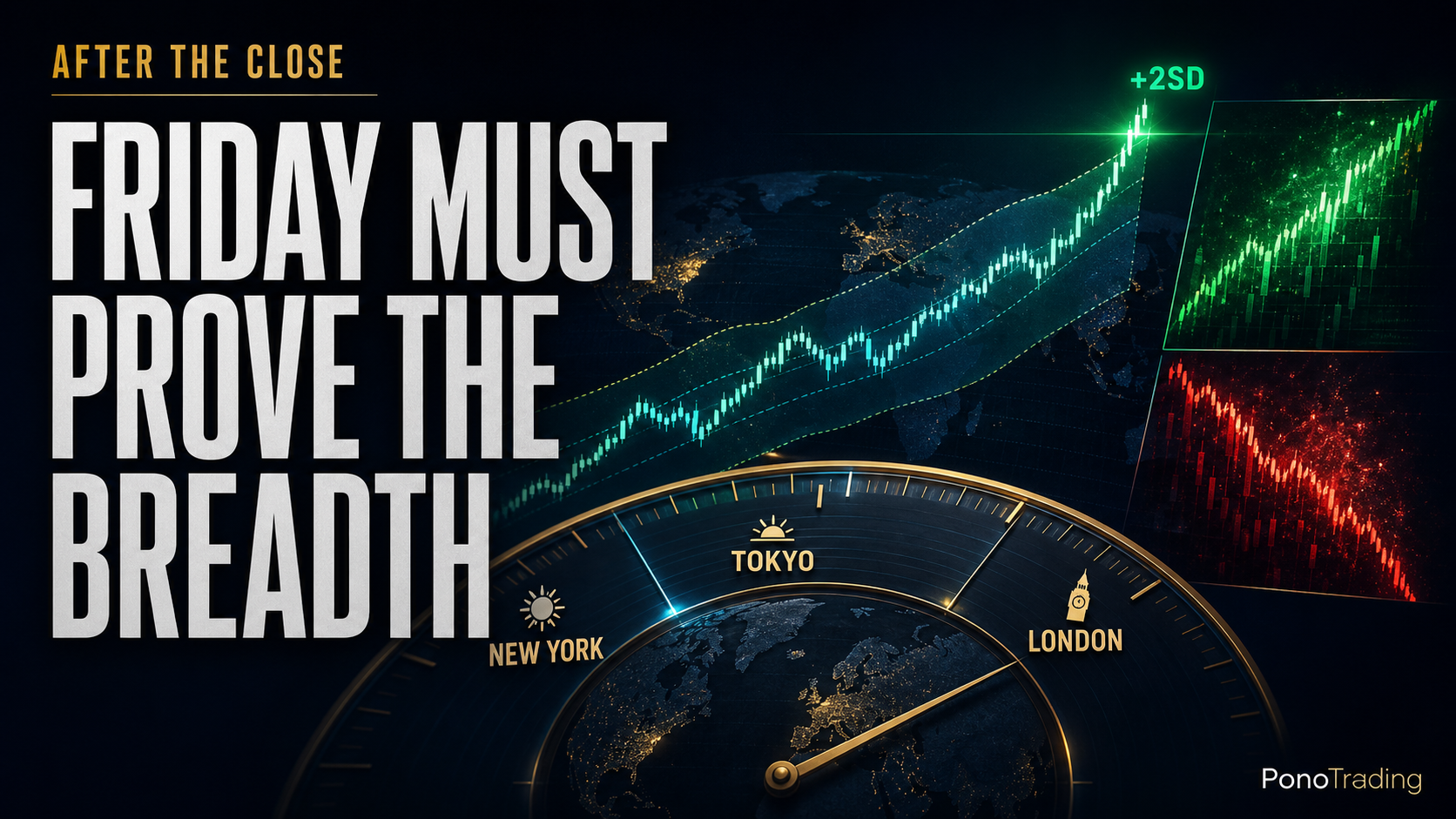
The Bounce Became Acceptance. Now Friday Has to Prove the Breadth.
NQ finished above the morning map's +2SD line, Amazon accelerated after hours, Apple slipped, and the BOJ plus month-end now control Friday's handoff.
Thursday, July 30, 2026
NQ finished just above the morning map's +2 standard-deviation line, every major U.S. index future closed above +1SD, and Wall Street recovered Wednesday's damage. The next test is whether Amazon's after-hours strength can carry the handoff through Apple, the Bank of Japan, Friday's inflation-sensitive data, and month-end flows.
The market did not need another prediction this morning. It needed a decision point.
Our Market Pulse identified 27,783.37 on NQ as the line separating a tradable AI rebound from another failed gap. NQ opened above it, never lost it during the regular session, and finished the 4:00 p.m. ET window at 28,230.75—six points above the map's +2SD level at 28,224.74.
That is not hindsight. It is exactly why we publish a map before the session begins. A level does not promise an outcome; it tells us what the market must prove before we commit risk.
Thursday proved acceptance.
The closing tape: powerful, but not indiscriminate
The official cash close was decisive:
- S&P 500: 7,437.63, up 1.7%
- Nasdaq Composite: 25,122.18, up 2.8%
- Dow Jones Industrial Average: 52,208.06, up 1.2%
- Russell 2000: 2,946.10, up 1.4%
The futures tape told an even cleaner story when measured against the levels published before the open.
| Market | Morning decision level | 4:00 p.m. ET observation | What price proved |
|---|---|---|---|
| NQ | +1SD 27,783.37 | 28,230.75 | Held +1SD all session and reached +2SD |
| ES | +1SD 7,430.75 | 7,472.75 | Reclaimed and accepted above +1SD |
| YM | +1SD 52,325 | 52,378 | Closed above +1SD |
| RTY | +1SD 2,946.93 | 2,954.00 | Closed above +1SD |
| WTI crude | Anchor 84.46 | 83.65 | Eased below the anchor instead of confirming inflation stress |
Futures values are delayed 5-minute observations near 4:00 p.m. ET, not official settlement prices or executable quotes.
NQ gave the cleanest confirmation. Its regular-session low was approximately 27,813, roughly 30 points above the bullish decision line. ES was less tidy early, trading below its +1SD level before buyers reclaimed it, but the final acceptance across all four index futures made the rebound more than a one-symbol squeeze.
Volatility agreed. VIX fell to roughly 17.34 from 20.66, while VXN dropped to about 27.80 from 30.84. Crude also backed away from Wednesday's level.
But this was not an all-clear signal.
The equal-weight S&P 500 proxy finished slightly lower even as the cap-weighted index surged, and the 10-year Treasury yield remained elevated near 4.66%. In plain English: the indexes had broad confirmation, but the force underneath them was still concentrated. Friday must show whether the rally can widen—or whether Thursday was primarily a high-powered repricing of the AI winners.
What actually drove the move
Microsoft was the center of gravity, gaining roughly 15.5% in its best session in nearly 18 years. The market rewarded Azure growth and, just as importantly, did not get another major upward shock to the company's AI spending plan.
That distinction mattered. Investors did not buy every AI story equally.
- Micron jumped about 18.4%.
- Lam Research gained roughly 18%.
- AMD rallied about 13%.
- Meta fell about 8% after a profit miss and a higher floor for expected capital spending.
The message was not simply “AI is back.” It was more demanding: show the revenue, show the operating leverage, and show that the spending is producing something measurable.
That helps explain why the bond market did not fully join the celebration. The Federal Reserve held rates at 3.50%–3.75% on Wednesday, but three officials preferred a quarter-point hike, and the statement said inflation remained elevated. Thursday's growth data softened, yet longer-term yields stayed high. Equity buyers won the session; the macro debate did not disappear.
Amazon delivered the cleaner after-hours handoff
Amazon gave the AI trade another strong proof point after the bell.
Second-quarter sales reached $200.6 billion, up 20%. AWS revenue grew 37% to $42.2 billion, its fastest growth rate in 18 quarters, while operating income rose 43% to $27.5 billion. The stock traded roughly 7%–9% higher in the early after-hours window.
There is an important quality check beneath the headline EPS. Amazon's $62.6 billion of net income included a $53.4 billion non-operating pre-tax gain, primarily tied to its Anthropic investment. Free cash flow also swung to a $7.6 billion outflow as capital expenditures accelerated, largely for AI infrastructure.
So the constructive read is not “EPS was enormous.” The constructive read is that AWS growth and operating income were strong enough for buyers to keep underwriting the investment cycle. Friday will tell us whether that enthusiasm survives a full session.
Apple beat—the stock still asked harder questions
Apple reported its strongest June quarter, with revenue of $109.4 billion, up 16%, and diluted EPS of $2.02, up 29%. iPhone revenue rose to $54.3 billion, while Mac and Services also set June-quarter records.
The composition matters. Apple's 50.1% gross margin included an approximately two-percentage-point benefit from tariff refunds, and EPS included an $0.11 benefit. Shares traded roughly 4% lower in the early after-hours window.
That reaction is useful information. A headline beat can still fall short of the market's quality bar when expectations are high and some of the upside is nonrecurring. Amazon was being rewarded for accelerating cloud demand; Apple was being asked how durable the margin and growth mix would be without the refund benefit.
The split gives NQ traders a clean overnight diagnostic: does Amazon's strength pull the complex forward, or does Apple's weakness cap the follow-through?
The Asia handoff: Japan can move more than Japan
When U.S. futures reopen, the first job is to compare the after-hours earnings reaction with Thursday's accepted levels. The old map remains useful as structure, but the new session will generate its own range and risk budget.
Japan then takes control of the macro handoff. Tokyo inflation and preliminary industrial-production data arrive before the Bank of Japan releases its policy decision and July outlook; the BOJ lists the release time as undecided.
Do not reduce that event to a single “hike or hold” headline. Watch the full transmission:
- The yen and Japanese government-bond yields can change the global-rate conversation.
- A disorderly move in USD/JPY can pressure leveraged risk positions well beyond Tokyo.
- Semiconductors and NQ need to hold their post-earnings bid if the Japanese session becomes more volatile.
The clean continuation case is NQ holding near or above 28,224.74, Thursday's +2SD line, while ES remains above 7,430.75 and Amazon strength spreads into semiconductors. A retreat below +2SD would not automatically break the rally. A loss of 27,783.37, especially with rising VXN and yields, would be the more meaningful failure.
London and Friday: inflation, energy and the month-end close
Europe inherits the BOJ reaction and then delivers a flash estimate of July euro-area inflation. The Bank of England held its policy rate at 3.75% Thursday in a 6–3 decision, so European rates and currency markets are already sensitive to any fresh inflation surprise.
Friday's U.S. session then carries several separate catalysts:
- 8:30 a.m. ET: Employment Cost Index, a direct read on labor-cost pressure
- Before the open: Exxon Mobil and Chevron earnings, with crude and Middle East risk still relevant
- 9:45 a.m. ET: Chicago PMI
- 10:00 a.m. ET: final University of Michigan sentiment and inflation expectations
- Into the close: month-end and week-end positioning, when flows can temporarily overpower an otherwise clean chart
The last point deserves respect. Friday is not just another continuation session. It closes a volatile week and the month at the same time. Late-day price can be informative, but it can also be inventory management. Confirmation should come from price, breadth, volatility and rates—not from one green candle.
Friday's decision tree
1. Continuation with confirmation NQ holds 28,224.74, ES holds 7,430.75, Amazon strength broadens into semiconductors, and VXN stays contained. That would suggest the market is accepting Thursday's repricing rather than merely squeezing through it.
2. Constructive digestion NQ rotates below +2SD but holds 27,783.37, while ES remains above 7,430.75. After a two-standard-deviation expansion, consolidation would be normal. The trade becomes location and patience, not chasing.
3. Failed acceptance NQ loses 27,783.37 and cannot reclaim it, ES slips back below 7,430.75, and yields or VXN rise together. That would reopen the possibility that Thursday's extension was concentrated positioning rather than durable demand.
These are reference conditions, not predictions. Fresh overnight expected-move levels should take precedence once the new session is established.
A strong trading day is not an edge until you can repeat the process
Thursday showed what a complete trading workflow is supposed to do.
The Market Pulse framed the question before the open. PonoTrading's chart tools keep expected moves, session structure and decision levels visible in TradingView and NinjaTrader. The Pono Trade Copier helps a multi-account trader execute one defined plan consistently across eligible NinjaTrader accounts instead of improvising account by account.
Then the work continues after the trade. FundedFlow lets traders review execution and performance in the journal while keeping the business side—evaluation fees, payouts, platform costs and other expenses—in the ledger. A green day in the platform is not automatically a profitable business month, and a good idea is not automatically a well-executed trade. Those need different records.
For anyone holding positions beyond one session, the same framework applies: map the catalyst, define what price must prove, size the risk, and keep an honest record of the result. That discipline scales from one account to a portfolio far better than another stream of disconnected trade calls.
The professional move tonight is not to celebrate Thursday. It is to write Friday's invalidation before Asia gets moving.
Build that workflow with the Pono Market Toolkit, or get the complete PonoTrading tool suite—including FundedFlow and the Pono Trade Copier—with Kahuna.
Market data note: Cash-index closes are official closing values reported after Thursday's session. Futures, volatility, rates and after-hours equity values are delayed observations captured around the U.S. close and early post-market period; they are not official settlements or executable quotes. Educational content only—not individualized financial advice.
Related Articles

After the Close Sept. 11: Twin Flip. Equities Closed Green. Week Still Red.
Twin flip: oil through daily −1SD off $102.48. Equities closed green (S&P +0.9%) and snapped the multi-day slide; week still finished red. Core CPI hot on the month. FOMC next week.

The Coupon Cleared. Oil Cleared 100. CPI Is Still Friday.
Tuesday reopened cash into supply and left the holiday book unfinished. Wednesday kept that frame, ran two auction clocks, and still had to live with Brent through 100. Equities finished lower again. The coupon was today’s duration print. CPI is still Friday.
After the Close Sept. 8: Cash Voted. The Holiday Fill Did Not.
First cash session after Labor Day. The holiday tape did not accept Thursday’s 29,201.26. Bills and the 3-year printed on two clocks. From the highs or the lows, the median was liquidity.