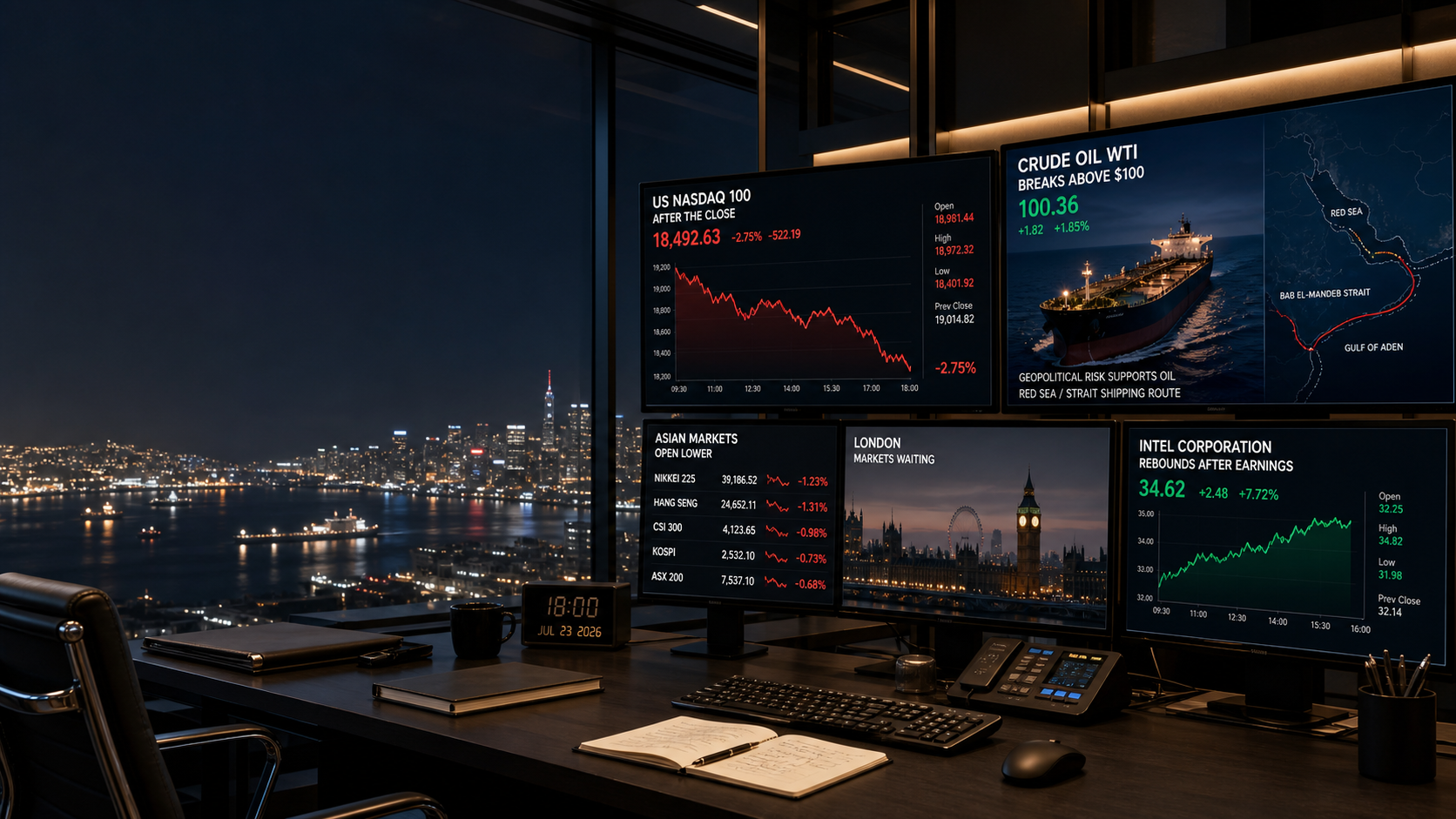
Oil Tops $100 as Big Tech Breaks — After the Close for July 23, 2026
Brent settled above $100, Nasdaq fell 2.2%, and Alphabet plus Tesla led the worst U.S. session in a month. Here is the live Asia read, Intel earnings response, and London handoff.
Thursday converted the morning's cross-asset warning into a full defensive session.
The S&P 500 lost 1.2%, the Nasdaq Composite fell 2.2%, and the Dow dropped 1.0%. The Russell 2000 held up better but still declined 0.7%. It was the U.S. market's worst loss in a month, driven by two pressures that reinforced each other: Brent crude settled above $100 as Middle East shipping risk intensified, while Alphabet and Tesla sold off sharply after earnings.
The close matters because the morning Market Pulse did not frame the opening weakness as an ordinary gap. It identified oil above daily +1SD, rising Treasury yields, and lower expected-move tests across the major equity ETFs as a volatility-expansion setup. Those signals persisted. Brent ultimately settled at $100.69, up 7%, after touching $102; the 10-year Treasury yield rose to 4.69%; and the Nasdaq never repaired the earnings-driven damage.
Asia has now been open for several hours. The early handoff is defensive: the MSCI Asia Pacific Index was down roughly 0.8%, with Japan, South Korea, and Australia lower. Nasdaq 100 futures were only slightly positive, while Intel's stronger earnings and guidance provided a narrow semiconductor offset. London therefore inherits a market that is trying to stabilize, not one that has repaired.
Closing Scorecard
| Market | Thursday close | Day | Overnight message |
|---|---|---|---|
| S&P 500 | 7,408.30 | -1.2% | Worst session in a month; closed below the morning SPY lower-band neighborhood |
| Dow Jones Industrial Average | 51,711.65 | -1.0% | Value exposure did not provide shelter from oil and rates |
| Nasdaq Composite | 25,137.69 | -2.2% | Clear downside leader as Alphabet and Tesla repriced |
| Russell 2000 | 2,940.16 | -0.7% | Relative outperformance, but still a second consecutive decline |
| Brent crude | $100.69 | +7.0% | Closed above $100 after touching $102; dominant macro catalyst |
| U.S. 10-year yield | 4.69% | +2 bps | Higher oil kept inflation and rate-hike risk active |
| Alphabet | — | -7.1% | Strong quarter was overwhelmed by concern about AI capital spending |
| Tesla | $319.69 | -14.5% | Weaker profit and heavy research spending drove the index-level drag |
The hierarchy is important. Nasdaq was much weaker than Russell, but this was not only a mega-cap story. Airlines and other fuel-sensitive businesses also fell sharply as the oil shock broadened into margins, consumer purchasing power, and interest-rate expectations.
What the Morning Map Got Right
The morning report centered the session on WTI $89.35, QQQ 692.83, SPY 738.52, IWM 290.43, DIA 515.76, and the 10-year yield near 4.70%.
WTI was already above its daily +1SD boundary at the morning freeze, and Brent accelerated further after attacks on two Saudi tankers in the Red Sea added another threat to Middle East energy routes. That expansion signal never meaningfully cooled.
The equity repair condition required crude to fall back inside its expected range, yields to retreat, and the major ETFs to reclaim and hold their lower daily boundaries. That combination did not arrive. The cash indexes instead closed near their lows, and the Nasdaq's 2.2% decline confirmed that the opening weakness had become a sustained repricing.
The result reinforces a core expected-move principle: a boundary touch is not the signal by itself. Acceptance outside the field while the source market continues expanding is the higher-quality information.
Oil Is Now a Financial-Conditions Event
Brent's move from below $72 early in July to a $100.69 settlement is large enough to change the macro conversation.
The latest surge followed attacks on Saudi tankers in the Red Sea while traffic through the Strait of Hormuz was already disrupted. The two routes are linked in the market's risk calculation. If producers cannot reliably use Hormuz or the Red Sea alternative, the issue extends beyond one day's geopolitical premium into freight, insurance, delivery timing, and available supply.
The transmission is visible:
- Higher fuel costs pressure airlines, transports, logistics, and consumer spending.
- Higher near-term inflation risk reduces the bond market's willingness to rally.
- Higher Treasury yields raise the valuation hurdle for long-duration technology.
- A firmer dollar increases the local-currency energy bill for many Asian importers.
- Energy producers can outperform without preventing broad-index weakness.
The 10-year yield rose to 4.69%, up from 4.67% Wednesday and far above the 3.97% area before the Iran war began. Markets also increased the probability assigned to a Federal Reserve hike. That is why Thursday cannot be classified as a simple growth scare: oil rose, yields rose, and equities fell together.
Alphabet and Tesla Failed the Conversion Test
Alphabet's operating results were strong. Cloud growth accelerated and quarterly investments in AI infrastructure nearly doubled from a year earlier. The stock still fell 7.1% after the company increased its full-year capital-spending forecast.
Tesla fell 14.5% after reporting weaker profit than expected, despite stronger revenue. Research spending and the cost of future initiatives remained central concerns.
Both reactions point to the same market demand: revenue growth is no longer enough by itself. Investors want evidence that large AI, autonomy, and infrastructure budgets convert into free cash flow and durable margins.
That makes Thursday's Nasdaq decline more consequential than a generic earnings miss. Two major companies reported different operating results, yet both were punished for the cost and return profile of future investment. Next week's hyperscaler earnings will face the same test.
Intel Adds a Narrow After-Hours Counterweight
Intel delivered the first constructive signal after the close. Second-quarter revenue rose 25% to $16.13 billion, adjusted earnings reached $0.42 per share, and both results exceeded consensus estimates. The company guided third-quarter revenue to $15.8 billion–$16.8 billion and adjusted earnings to $0.38 per share, also above expectations.
Intel shares rose in extended trading, while other chip names received a smaller lift. The report supports the view that AI data-center demand remains strong, especially for CPUs and infrastructure.
It does not erase Thursday's broader warning. Intel also raised planned capital spending, and the market is explicitly questioning the returns on large investment programs. The better overnight signal would be Intel holding its gains while Asian semiconductor breadth improves and Nasdaq futures recover. One green stock against weak regional indexes is stabilization, not confirmation.
Asia Session: Live Handoff
The early Asia session is reflecting the U.S. close more than Intel's rebound. The MSCI Asia Pacific Index was down about 0.8%, with benchmarks in Japan, South Korea, and Australia lower. Brent remained near $100, the dollar stayed firm, and the yen traded near 163.83 per dollar.
Three relationships deserve priority:
1. Semiconductors versus the broad tape
Intel's outlook can support memory, server, foundry, and data-center suppliers. If that strength broadens while the regional indexes remain weak, the market is separating durable AI demand from Alphabet's spending concerns. If semiconductor shares cannot respond, the U.S. de-risking impulse is still dominant.
2. Energy importers versus exporters
Japan, South Korea, India, and much of Southeast Asia are sensitive to imported energy costs. Brent above $100 plus a stronger dollar is the more difficult combination because it raises the local-currency oil bill. Watch airlines, transports, utilities, refiners, and regional currencies together.
3. Futures stabilization versus cash-market confirmation
Nasdaq 100 futures were only modestly positive early in Asia. That is not yet a reversal of a 2.2% cash-session decline. A durable repair needs futures to build above the post-Intel range while Asian breadth improves and Brent stops making new highs.
London Handoff
Europe sold off sharply Thursday as oil and sovereign yields rose. France's CAC 40 fell 1.6%, while the European Central Bank held rates steady and left markets alert to a possible future hike if inflation pressure persists.
London receives a mixed sector setup:
- FTSE energy exposure can support the headline index while Brent remains above $100.
- Airlines, transports, industrials, and consumer cyclicals face direct cost pressure.
- Higher global yields can weigh on property, utilities, and other rate-sensitive groups.
- A stronger dollar can help some multinational revenues while worsening imported-energy costs.
The constructive London handoff would show Brent losing the $100 area, Intel holding its after-hours gain, Asian semiconductor breadth improving, and U.S. index futures extending their rebound.
The defensive handoff would show Brent accepting above $102, Asian import-sensitive sectors making new lows, the dollar and yields rising together, and Nasdaq futures surrendering the Intel-led bounce.
Friday's New York Catalysts
Friday brings the first broad read on July business conditions.
| Time (ET) | Event | Why it matters |
|---|---|---|
| 9:45 a.m. | S&P Global flash U.S. manufacturing and services PMIs | Tests whether activity is absorbing the energy and rate shock |
| 10:00 a.m. | June new-home sales | Measures housing demand under elevated mortgage rates |
| All session | Iran, Hormuz, and Red Sea headlines | Remains the highest-impact unscheduled catalyst |
The PMI price components may matter as much as the headline activity readings. Strong activity with hotter input prices could keep yields elevated. Softer activity with easing oil would be more supportive for bonds, but a sharp growth disappointment could pressure cyclicals.
Three Overnight Scenarios
Constructive Repair
Brent falls back below $100, Intel holds its gain, Asian semiconductor strength broadens, and Nasdaq futures build above the early rebound. Yields stabilize below Thursday's high. In this path, the U.S. decline remains severe but begins to look like a concentrated earnings-and-oil reset rather than the start of disorderly liquidation.
Rotation Without Full Repair
Oil stays near $100, energy outperforms, Intel remains firm, and major index futures trade sideways. Asian and European headline indexes stabilize while airlines, transports, and rate-sensitive groups stay weak. This is selective risk transfer, not a broad risk-on signal.
Defensive Expansion
Brent accepts above $102, yields and the dollar rise, Asian import-sensitive sectors weaken further, and Nasdaq futures reject the Intel bounce. Agreement across those markets would carry Thursday's volatility expansion directly into London and Friday's New York session.
Bottom Line
Thursday resolved the morning setup defensively.
Brent settled at $100.69, the 10-year yield rose to 4.69%, the Nasdaq fell 2.2%, and Alphabet plus Tesla showed that strong revenue cannot overcome concerns about the cost and return profile of future investment. The Russell's relative resilience prevented the session from becoming indiscriminate liquidation, but it did not produce a close-based repair.
Intel's strong report gives the overnight market a legitimate counterweight. Asia's early decline shows that one earnings beat has not yet offset the combined pressure from oil, rates, and the U.S. technology selloff.
The overnight checklist is direct: Brent at $100–$102, Intel's after-hours range, Asian semiconductor breadth, USD/JPY near 163.83, Nasdaq futures, and whether London energy strength can coexist with stabilization in transports and cyclicals.
If oil cools and Intel's signal broadens, the market can begin repairing Thursday's damage. If oil extends while yields and the dollar remain firm, treat London and Friday's U.S. open as continuation of the volatility-expansion regime.
Source note: U.S. cash-index closes, Brent settlement, Treasury yields, major-stock moves, and geopolitical context were checked against Associated Press reporting. Intel results and guidance were checked against Reuters reporting and company figures. Early Asia references are live-session snapshots and may change materially before local closes. Expected-move levels are the static PonoTrading volatility-derived ranges published Thursday morning; they are reaction zones, not forecasts.
Educational content only. Not financial advice. Futures, options, equities, and digital assets involve substantial risk and are not suitable for every trader.
Related Articles

Buy Levels Marked the Lows
The board sent 17 setups in New York cash. Two hourly buy levels marked the ES and NQ session lows, a quarter point over Friday's settles. The YM and RTY sell levels failed, and both closed outside their expected move.

Back Under by the Close
The board sent 35 hourly setups overnight and in cash. NQ got back over its 6:38 a.m. sell level, ran 225 points, and gave it all back. Price finished under all five morning sell levels.

Expiration Date
PonoTrading's board sent 28 hourly setups, 5 Daily, and 1 Weekly. On expiration Friday the overnight highs were the tops: the S&P fell 1.1%, the Nasdaq 2.1%, and four of five cash buy levels broke.